Podcast
Quick clarification that surprises a lot... | Georgia Telehealth Therapy
May 30, 202619 min (19:08)
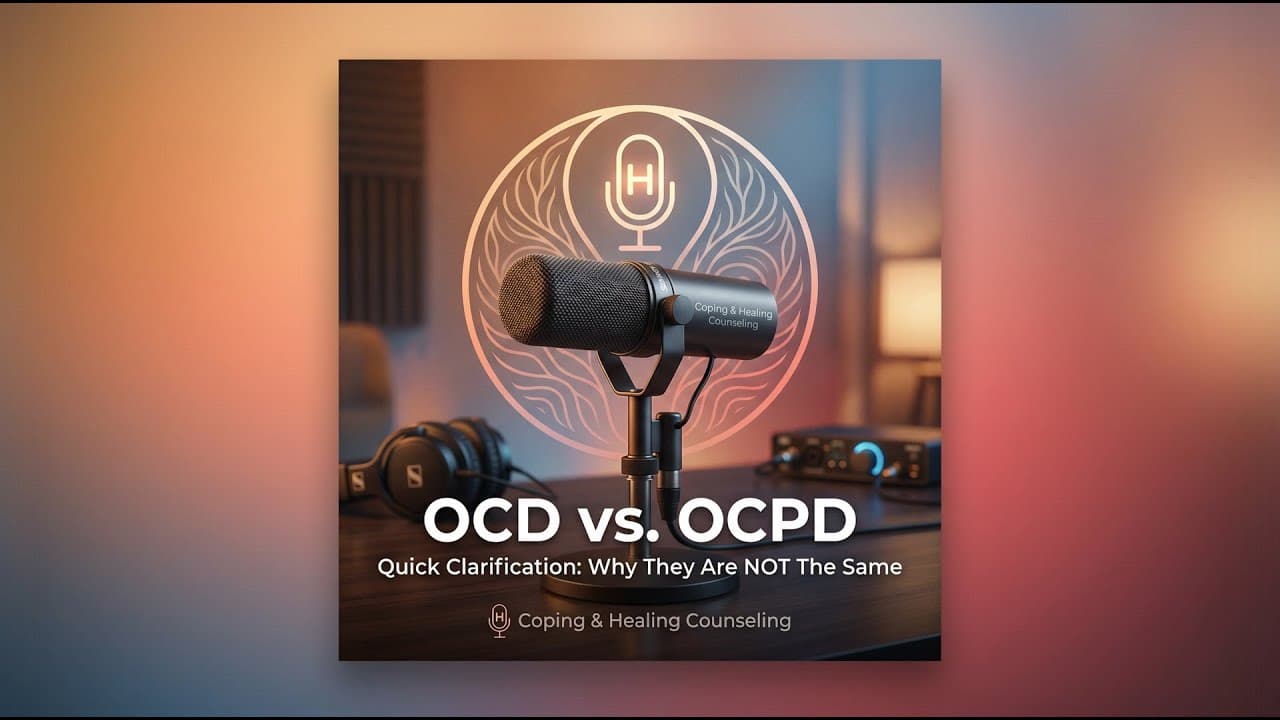
Quick clarification that surprises a lot of people: OCD and OCPD are NOT the same thing. OCD is driven by intrusive thoughts and compulsions a person desperately wishes would stop. Obsessive-Compulsive Personality Disorder (OCPD) is a lifelong pattern of perfectionism, rigidity, and need for control Generated from Coping & Healing Counseling: Accessible Telehealth for Georgia #CopingAndHealing #GeorgiaTherapy #Telehealth #MentalHealth #Podcast
Show transcript (3,480 words)
You know, it is just wild how um certain highly specific clinical terms somehow drift into our everyday vocabulary and just completely lose their meaning. Like someone organizes their spice rack alphabetically or I don't know, they align the pins on their desk perfectly parallel and they just casually throw out, "Oh, I'm so OCD about my kitchen." >> Oh, yeah. It happens all the time. It really becomes a punchline or um almost a quirky badge of honor for some people. You know, people use it as this quick shorthand for just being organized or detail oriented, >> right? But if you actually understand the clinical reality of that disorder, you realize it is uh it's not a punchline at all. I mean, it is practically a psychological hostage situation >> completely. And it's an incredibly vital distinction to make because the lived reality for individuals dealing with these conditions is often deeply frustrating and frankly profoundly misunderstood by the people around them and honestly even by the individuals themselves. >> Exactly. So welcome to another deep dive. We are doing a deep dive today into this massive frequently misunderstood divide in mental health. One that gets casually mislabeled constantly. So our mission is we are breaking down the profound difference between OCD and OCPD. >> Yes. Which is so needed. >> And then you know because understanding the problem is really only half the battle. We are going to look at how modern healthcare logistics are actively evolving to actually treat these complex conditions. >> Right? because access to care is the other huge piece of this puzzle >> for sure. So for you listening, we've got a really focused stack of sources today. We are pulling clinical insights from a brief titled distinguishing OCD from OCPD, clinical insights and care access. And we're pairing that with some fascinating operational details from coping and healing counseling or CHC >> which is great because it gives us a real world look at how the treatment landscape is actually changing right now. Okay, let's unpack this because right out of the gate, we need to establish the fundamental line in the sand. Like what is the absolute most important takeaway here, >> right? So the line in the sand is that obsessivecompulsive disorder or OCD and obsessivecompulsive personality disorder, OCPD, are entirely distinct conditions. >> They aren't just like cousins. >> No, not at all. They are not variations of the same thing. They operate on completely different psychological mechanisms. And you know that difference dictates everything about a person's lived experience and crucially how they need to be treated. >> Okay, let's start with the one everyone thinks they already know, right? OCD. I was reading through the clinical notes before we started and the single word that actually stopped me in my tracks was unwanted. >> Yes, unwanted. That's the core of it. >> It's not that someone with OCD simply prefers washing their hands or, you know, checking the locks. It's that they are literally terrified of what happens if they don't. That is the crucial differentiator right there. OCD is driven by intrusive unwanted thoughts and compulsions. Like this is not a personality trait or a simple preference for order. It is an external intrusion into a person's mind. The core emotion driving OCD is not um satisfaction when a task is completed. It is highlevel absolute distress. They desperately wish these thoughts would stop. It makes me think of like having a vicious computer popup virus. You know, when you were just trying to do your work and suddenly this glaring loud alarm bell pop up just hijacks your entire screen. >> Oh yeah, the worst. >> Right. It's completely unwanted. It's highly disruptive and you were just frantically clicking the little X in the corner to make it go away. You're just trying to regain control of your own desktop, but the pop-up just keeps returning. >> That is such a good way to put it that perfectly visualizes the internal mechanism of OCD. The person recognizes the popup as a virus. They know it does not belong there. >> Right. They see it as external. >> Exactly. The intrusive thought is the popup. And the compulsion, whether that is, you know, checking a lock 50 times or counting steps is the frantic clicking of the X. They are just trying to neutralize the overwhelming anxiety caused by the intrusion so they can just get back to their life. I mean, they absolutely do not want to be experiencing this. >> Which leads to such a fascinating psychological pivot for our deep dive today. Because if OCD is that unwanted pop-up virus you are desperate to stop, what happens when you don't actually want to click the X, >> right? >> Like what happens when those rigid obsessive behaviors actually feel like they are your brain's correct operating system? >> And that takes us directly into obsessivempulsive personality disorder, OCPD. What's fascinating here is that it shifts entirely from an unwanted intrusion to a pervasive lifelong pattern. >> Wow. >> Yeah. We are no longer talking about a distressing pop-up. We are talking about a deep-seated framework of perfectionism, extreme rigidity, and just an intense need for control. >> And there is a vital clinical term from our research that really is um kind of the skeleton key to understanding this whole puzzle. Egoonic. The insights highlight the key distinction of OCPD is that the behaviors are egoonic. >> Yes. So in psychology, if something is egoistonic like OCD, it conflicts with your ideal self-image. It feels alien like the virus, >> right? >> But if a trait is egoentonic, it feels completely aligned with your worldview. It feels like an integral part of your very identity. >> Okay, here's where it gets really interesting to me because wait, if it's egoentonic, does that mean the person actually enjoys being this rigid? It are they having a good time with all this intense need for control? >> That's a great question, but um enjoyment probably isn't the right word. Okay. >> It is more about a profound sense of correctness. When we say it feels appropriate to the person, it means they genuinely believe their way of doing things is fundamentally the optimal way the world should operate. >> So they think they're just right. >> Exactly. It doesn't necessarily make them happy. In fact, it often makes them quite miserable and stressed out, but they cannot fathom doing it any other way because they believe their standard is the only right standard. >> Let's look at the specific manifestations of this because it goes way beyond just wanting a neat desk. The clinical notes outline um a severe preoccupation with rules, lists, and order. >> Right. >> And it also highlights an extreme difficulty delegating tasks, which honestly makes total sense when you understand the egoonic piece. >> Oh, absolutely. >> Because if you believe your standard of perfection is the only correct standard in the entire universe, handing a project over to a co-orker or even like a simple chore over to a spouse, it feels basically impossible. You just know they inevitably won't do it right. >> And the mental math they do is that if a task isn't done perfectly, it is a catastrophic failure. There's no middle ground. So, they take on everything themselves. >> That sounds exhausting. >> It really is. And that connects directly to another symptom outlined in the text, which is workcoholism at the severe expense of relationships. Yeah. The drive for control and perfection in their professional life completely eclipses their interpersonal connections. I mean, there is no time for a casual dinner with a partner when you are compelled to rewrite a perfectly fine report for the fourth time, >> right? The research also points out inflexible stances on morals and ethics, like the world is seen in incredibly stark black and white. And interestingly, it even mentions trouble discarding worn out items, which I was wondering, why would a perfectionist hoard old things? >> Well, because OCPD is fundamentally about rigid rules and utility. So throwing away something that might have some hypothetical future use violates a rigid internal rule about waste or efficiency. >> Oh, I see. >> Yeah. It's not necessarily about sentimental attachment to the item. It is an inflexibility about the quote unquote correct way to manage resources. >> It is so much like being the only person at a game night who sat down and read the entire 50page rulebook to a complicated board game. You are genuinely baffled and probably incredibly irritated that everyone else is just having a drink and playing casually because in your mind everyone else is just playing life wrong. You are just trying to enforce the rules that supposedly keep the entire universe from collapsing into chaos. >> That is a perfect analogy. And not only did they read the 50-page rule book, they believe that if anyone breaks even a minor rule, the integrity of the entire game is just destroyed. Wow. >> And that analogy actually highlights a massive logical puzzle that clinicians face. If a person with OCPD genuinely thinks they are just doing it right and everyone else is falling short, well, why would they ever seek help? >> Yeah. They wouldn't. >> Exactly. If their behavior is egoentonic, they aren't going to wake up one morning and say, you know, I think I need therapy to fix my excellent attention to detail. >> Right. So, they don't. That means we have to look at the breaking point. The insights explain that because OCPD is hidden in plain sight as part of their identity, it is rarely recognized by the individual directly. >> It only surfaces clinically when the collateral damage of that rigid behavior becomes completely impossible to ignore. >> What does that damage look like? >> Well, the source specifically points to three major areas of fallout. Severe relationship strain, total burnout from that relentless workcoholism, or deep depression. Okay, let me play Dell's advocate for a second here. If someone is finally going to the doctor just because their marriage is falling apart or they are profoundly depressed and burned out, isn't there a massive risk the clinician just, you know, treats the depression? >> Oh, a huge risk. >> Like they just put a band-aid on the burnout, maybe prescribe something to help them sleep and completely miss the 50-page rule book that is actually driving the whole thing. You've hit on the exact reason why the source insists on a very specific standard of care. This is a very real danger in the medical field. It is exactly why the text emphasizes that a diagnosis must come from a fully licensed clinician >> because it's so easy to miss. >> Exactly. It requires a professional who is highly trained to look at that co-occurring depression or anxiety, recognize it as merely the presenting symptom, but actually possess the clinical skill to spot the egoonic OCPD framework operating underneath that all. >> Okay. So once that licensed clinician actually spots the underlying OCPD or properly identifies the distress of OCD for what it is, what is the path forward? What does the treatment actually look like? The encouraging news here is that highly specialized therapy genuinely works, but it has to be the right kind. The clinical insights point to evidenceinformed care, specifically listing psychonamic therapy, cognitive behavioral therapy, which is often called CBT, and schema therapy. >> Wait, before we go further into the logistics of getting care, can we demystify some of that jargon? Yeah. Because like what actually is schema therapy, for example, and how does it fix a personality disorder? Apply the explain it to me like I'm five rule here. Okay, fair enough. So, think of cognitive behavioral therapy or CBT as identifying and rewiring your immediate thoughts. It teaches you to catch yourself when you are demanding perfection and consciously challenge that thought in the moment. >> Okay, that makes sense. >> And psychonamic therapy looks deeper at unconscious drives and past experiences. >> Okay. So, CBT is kind of like pruning the bad branches off a tree as they grow. What about schema therapy? >> Schema therapy is digging up the roots. >> Oh, wow. Yeah, it is designed specifically for deep-seated personality disorders like OCPD. A schema is a core blueprint or life rule that you usually develop in childhood. >> So for someone with OCPD, what's their blueprint? >> Their underlying schema might be something like if I am not perfectly in control, I'm unsafe or unlovable. >> That's heavy. >> It is. And schema therapy slowly helps the person recognize that this outdated blueprint is actually what's destroying their marriage or causing their burnout. and it helps them write a new healthier blueprint. >> Okay, so we know this requires intense, highly specialized professional therapy. But let's be real. If someone is already completely burned out from OCPD or paralyzed by the intrusive thoughts of OCD, asking them to research therapists, drive 45 minutes across town in traffic, and navigate confusing billing, >> I mean, that is just going to feel like another impossible rulebook. >> It really is. >> The logistics themselves become the barrier. Yeah. >> So, how is the industry actually solving that? >> If we connect this to the bigger picture, the logistics are often the exact point of failure. The absolute best schema therapy or CBT in the world is completely useless if a burned-out depressed person cannot access it. >> Right? >> When someone is already at the breaking point, the logistical hurdles of finding an expert can just be an insurmountable wall. >> And that brings us to the operational side of our research. Today we are looking at coping and healing counseling or CHC not just as a clinic but as a model for how modern care is actively breaking down those exact barriers. >> It's a great case study. >> The scope of their practice directly targets the access problem. First of all, they are a 100% telealth practice. It is fully HIPPA compliant and they serve all 159 counties in Georgia. >> Moving to statewide coverage through a teleaalth model is a massive logistical shift. >> It really is. Now, if you're listening to this and thinking, um, can a video call really fix a deep-seated personality disorder like OCPD? >> You know, that is a totally fair question. But why is this specific teleaalth model so critical for this exact population >> because it completely removes the friction? If you have OCPD, any inefficiency like sitting in traffic, waiting in a lobby, or dealing with a disorganized front desk is a reason to get frustrated and just quit therapy. >> Right. Because it violates the rules of efficiency. >> Exactly. By removing the physical commute entirely, tellahalth eliminates the easiest excuses to avoid treatment. You can literally access top tier clinical help from your own home on your own schedule. >> But you know, the platform is only as good as the people on it. The source also highlights the makeup of the clinical team at CHC. They have a team of over 15 licensed therapists, including LCSWs, LPC's, and LMFTs. >> Right. >> Let's unpack that alphabet soup real quick so we know who we are actually talking to. >> Sure. So, an LCSW is a licensed clinical social worker who looks at the patient not just psychologically but within their environment and community context. >> Got it. >> An LPC is a licensed professional counselor who focuses heavily on mental health and emotional disorders. And an LMFT is a licensed marriage and family therapist, which is obviously critical since we know OCPD severely strains relationships and family dynamics. >> That makes perfect sense. And crucially, the notes explicitly state they are a diverse and culturally competent team. Why is cultural competence so critical here? >> Because when you are dealing with deeply personal issues like family dynamics, morals, and identity, which are exactly the things OCPD rigidifies, you really need a therapist who understands the cultural background of those morals. Rules and perfection are culturally subjective. A culturally competent therapist can distinguish between a deeply held cultural value and an egoonic pathology. >> That is such a huge point. And their specialties cover exactly what the OCPD and OCD fallout looks like. They treat individuals, couples, families, and teens ages 13 and up. And they specialize in anxiety, depression, trauma, and PTSD, grief, relationships, and stress. >> Yeah. It is a comprehensive safety net designed to catch the collateral damage of these disorders, no matter how it presents. >> Let's ground this in practical reality, though, because for you listening, the biggest barrier to entry is almost always the cost. Mental health care can be notoriously expensive and frankly confusing to pay for. >> Oh, absolutely. >> But the financial realities outlined for CHC are genuinely accessible. We are looking at explicitly stated costs here from the source. Medicaid has a $0 co-pay and if you are on commercial insurance like Etna, Sigma, Blue Cross, Blue Shield, United Healthcare or Humanana, the sessions range from just $10 to $40 a session. >> When you synthesize that teaalth model with those specific financial figures, you see a direct treatment for the quote unquote burnout mentioned in the clinical text. >> Yeah, it just makes sense. >> By making the care financially manageable and removing the commute, you drastically lower the barrier to entry. you're making it highly probable that someone dealing with the heavy fallout of unchecked OCPD or the distress of OCD will actually get into the virtual room with a licensed professional. >> And for anyone listening who hears themselves or maybe a loved one in this deep dive and wants to look into this model, the contact info is really straightforward. You can reach CHC by phone at 404-832102 or online at treat theapy.com and via email at support at cheap theapy.com. >> It really is a critical resource to highlight, especially when you consider just how isolating both of these conditions can be. >> They really are. >> Yeah. OCD isolates a person through internal distress and fear, locking them in a cycle of unwanted compulsions. OCPD on the other hand isolates a person through relationship strain and an inability to connect with others who just do not share their rigid 50page rulebook. >> It totally reframes the whole conversation. I mean understanding the deep divide between the unwanted distressing intrusions of OCD and the rigid egoonic identity of OCPD can fundamentally change how you view yourself or how you view your co-workers, your friends and your family. >> Definitely >> it replaces frustration with clinical clarity. you realize they aren't just being difficult. They're operating under a completely different internal framework. And knowing that accessible, effective, evidence-informed care actually exists and that the logistical barriers to getting it are falling away is incredibly empowering. >> It reinforces the absolute value of seeking out licensed, culturally competent professionals. We really cannot rely on internet buzzwords to diagnose ourselves or the people around us. >> So true. When you are dealing with complex overlapping layers of mental health like a spouse presenting with severe depression that is actually masking lifelong OCPD, you need an expert to untangle that web, >> right? I mean, you wouldn't just guess at how to fix a complex computer virus. And you definitely shouldn't guess at the operating system of the human mind either. >> A proper diagnosis is the only way to ensure the right therapeutic tools are used. Whether that is CBT to manage the immediate anxiety or schema therapy to rewrite those deep-seated core beliefs. >> We have covered a lot of ground today from the internal mechanisms of these conditions to the modern logistics of treating them. But I want to leave you with a final lingering question to ponder on your own. >> Love these. >> It's something that builds on everything we've unpacked today about how these behaviors actually function in the real world. Think about the symptoms of OCPD. discussed the extreme workcoholism, the intense need for control, the absolute demand for perfection, and the refusal to delegate. >> Right? >> If our society so highly rewards things like extreme perfectionism, tense rule following, and workholism in our careers, often promoting the people who exhibit these traits to the very top of the ladder, how often are we inadvertently celebrating the very symptoms of OCPD, right up until the exact moment a person completely burns out?